
Commercial Roof Replacement in Ceres, CA
In short: In short: this page covers commercial roof replacement in Ceres, CA 95307 — TPO, EPDM, and modified bitumen systems for offices, retail, and warehouses along Mitchell Road and the CA-99 corridor. Phased work keeps your business open; coatings are quoted honestly when the membrane qualifies. First step: a free inspection with core samples and a drainage survey.
Commercial roof replacement is a different discipline from residential: larger surfaces, occupied buildings below, rooftop equipment everywhere, and a business that cannot stop while the work happens. Our commercial replacements in Ceres are planned around your operations — phased sections, off-hours work where needed, and constant communication with your facilities team.
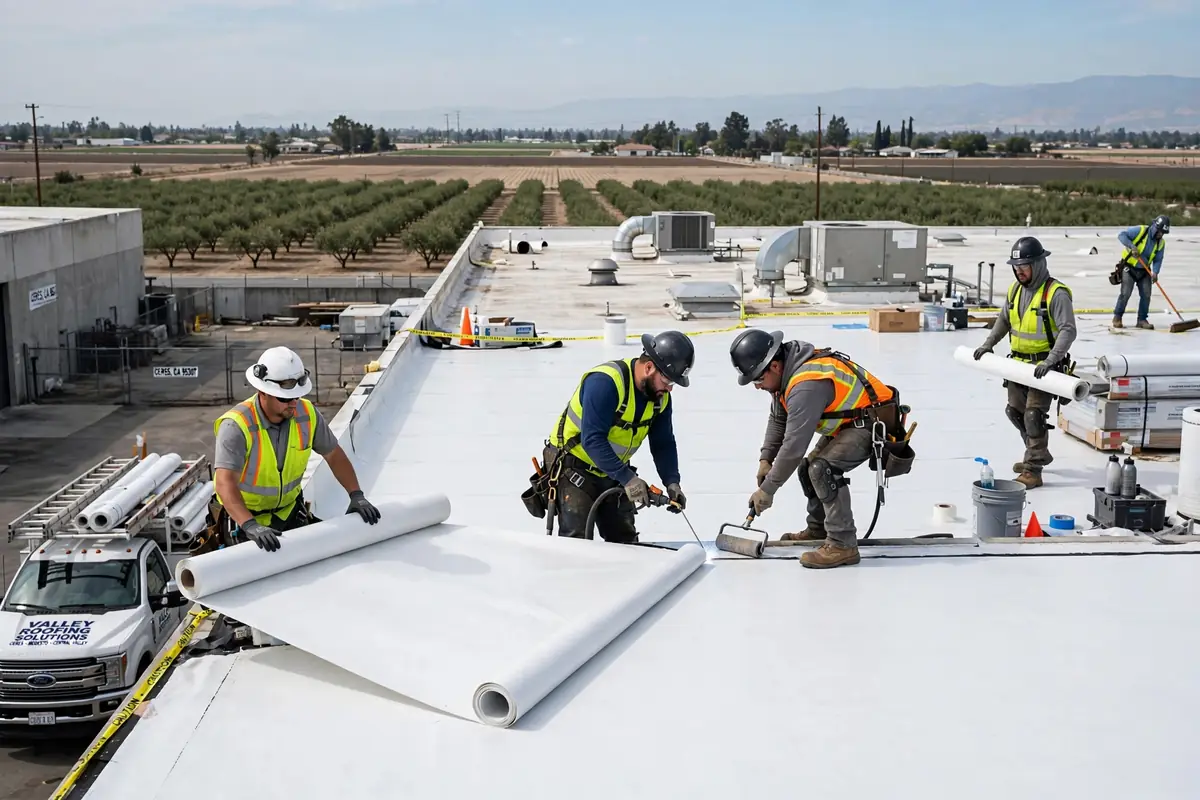
What This Service Includes
We survey the entire roof including core cuts to map wet insulation, design the new assembly (typically TPO, EPDM, or modified bitumen over tapered insulation), phase the tear-off so your building is never exposed, and coordinate around HVAC, vents, and equipment curbs. Every phase ends each day watertight.
Signs You Need This Service
- Recurring leaks disrupting operations
- Wet insulation found in core cuts or infrared scans
- Ponding water across large areas
- A roof past its warranty with rising maintenance costs
- Energy bills climbing from saturated insulation
How We Do It Right
We install 60- and 80-mil TPO and EPDM, as well as multi-ply modified bitumen where the application calls for it. Tapered insulation design corrects drainage, new flashing details seal every penetration, and we provide manufacturer warranties up to 20-30 years with maintenance plan options. Safety planning, daily cleanup, and tenant communication are built into every commercial project.
Commercial Roof Replacement for Ceres Homes
Ceres businesses cannot pause for a roof project. Our phased commercial replacements keep your building watertight and operational from first tear-off to final inspection.
Related Roofing Services
Roof Tear-Off & Redecking
Complete tear-off to the deck with damaged sheathing replaced — the foundation every long-lasting Ceres roof needs.
Emergency Roof Replacement
Emergency dry-in and fast-tracked full replacement for Ceres homes with active leaks or storm damage. Call line answered 24/7.
Partial Roof Replacement
Targeted replacement of damaged roof sections for Ceres homes — matched materials, proper tie-ins, full warranty on our work.
Energy-Efficient Cool Roof Replacement
Cool-roof replacement in Ceres: reflective shingles, metal, or membranes that cut attic heat and cooling costs.
Areas We Serve
Mayfield
Roof replacement in Mayfield, Ceres.
River Meadows
Roof replacement in River Meadows, Ceres.
Bing Cherry
Roof replacement in Bing Cherry, Ceres.
Whitmore Ranch
Roof replacement in Whitmore Ranch, Ceres.
Helpful Guides
How Much Does Roof Replacement Cost in Ceres?
Guide from Roof Replacement Solutions.
Roof Warranties Explained: What Ceres Homeowners Actually Get
Guide from Roof Replacement Solutions.
Systems for Ceres commercial buildings
Three systems cover nearly every commercial roof in Ceres. TPO is the default for most low-slope buildings: heat-welded seams stronger than the sheet itself, bright white surface that meets California's Title 24 cool-roof requirements on reroofs, and 20–30 year life at the best cost per year. EPDM (rubber membrane) suits buildings with complex penetrations and rooftop equipment — it flashes details cleanly and tolerates building movement. Modified bitumen (torch-applied or self-adhered) fits high-traffic roofs that need puncture toughness. When the existing membrane is dry, sound, and well-attached, a silicone or acrylic restoration coating can add 10–15 years at a fraction of replacement cost — we core-sample first and only quote coatings when the roof earns it.
The assembly beneath the membrane
The membrane is the skin; the assembly decides the life. We design tapered polyiso insulation so water actually reaches the drains — ponding is the number-one killer of Ceres flat roofs, and most of them were built dead flat. A cover board goes over the insulation for hail and foot-traffic resistance. Attachment is engineered: mechanically attached for most decks, fully adhered where Delta wind exposure or noise rules demand it. Perimeter edge metal is fabricated to ANSI/SPRI ES-1 wind standards, because edges are where wind failures start. Every penetration gets a proper curb and flashing detail — the five-minute caulk fix is how the last roof failed.
What moves the price in Ceres
Five things decide the number: total square footage, insulation package (thickness and tapered design), the count of penetrations and HVAC curbs, access and staging (a clear Mitchell Road lot versus a tight downtown building), and tear-off versus recover. A recover — one new system over one existing roof — is legal and smart when the old roof is dry and firmly attached; it saves the tear-off cost and keeps the building watertight throughout. When the deck is wet or there are already two roofs, tear-off is mandatory. We quote per square (100 sq ft) with insulation, membrane, flashing, and edge metal itemized — so a competing bid can be compared line by line, not guessed at.
Built for the Valley
Ceres commercial roofs live a hard life: 100-degree summer days that cook membranes, winter cloudbursts that find every low spot, and Delta wind events that test every edge and coping. We design for all three — tapered drainage for the cloudbursts, ES-1 edge metal for the wind, reflective surfaces for the heat. California's Title 24 already pushes cool-roof performance on most commercial reroofs; we design to exceed it. Scheduling respects your business: noisy tear-off phases run early or off-hours, tenants get written notice schedules, and phased sections keep you watertight and open every single day of the project.
Coatings: when restoration beats replacement
Not every aging commercial roof needs a new membrane. When core samples show dry insulation and a sound, well-attached membrane, a silicone restoration coating adds 10–15 years at a fraction of replacement cost — with Title 24-compliant reflectivity as a bonus. We quote coatings only when the roof earns it: wet insulation or a failing deck means replacement, honestly stated. The core samples decide, not the sales target.
Frequently Asked Questions
Will we need to shut down during replacement?
Rarely. We phase the work so only one section is open at a time, keep noise and odor controlled, and can schedule disruptive operations for off-hours. Most businesses operate normally throughout.
How do you handle rooftop HVAC and equipment?
We coordinate with your mechanical contractors, temporarily detail around equipment, and install new curbs and flashing as needed. Equipment stays in service except for brief, scheduled windows.
Can you replace our roof without closing the business?
Almost always yes. Commercial replacements are phased by section: we tear off and dry in one area while the rest of the building operates normally. Noisy work is scheduled early mornings or weekends by agreement, and every phase ends watertight the same day. Tenants and customers notice the trucks, not a shutdown.
Recover or tear-off — how do you decide?
By evidence, not preference. We take core samples across the roof and scan for trapped moisture. One dry, well-attached roof: recover is allowed and economical. Two roofs, wet insulation, or a failing deck: tear-off is required by code and by physics. We show you the cores and the moisture readings — the roof itself makes the call.
How long does a commercial roof last in Ceres?
TPO and EPDM: 20–30 years with the drainage corrected and seams maintained. Modified bitumen: 20–25. A restoration coating: 10–15 over a qualifying roof. The Valley's UV is the main aging force — reflective surfaces and annual inspections (drains, seams, penetrations) are what get a membrane to year 25 instead of year 15.
How do you minimize disruption to our tenants?
By phasing and communication. Work proceeds section by section — each phase ends watertight the same day — noisy operations are scheduled around your hours, and tenants receive written schedules in advance. Most tenants notice the trucks and the new roof, not a disruption.